
Maryland Soybean Board Funds Research
While experts already know how the kudzu bug spends its summers – destroying crops by munching on kudzu vines and other hosts, including soybeans – researchers want to know more about how these insects spend their winter.
That’s the focus of two studies funded by the Maryland Soybean Board (MSB) this summer. The checkoff board granted more than $200,000 to support 16 research projects for the benefit of soybean farmers.
University of Maryland researcher Jessica Grant wants to know just how cold it needs to be in order to kill a resident population of kudzu bugs.
Previously, Grant has performed observations of the number of days to hatch, percent which survive, days to adulthood, average age per female, and longevity of the insects in four different controlled temperature regimens. She also looked at which point the bugs will actually freeze and die, trying to correlate that with what they would experience in the field.
The primary issue lies in the fact that kudzu bugs overwinter in leaf litter which serves as an insulating microhabitat for the insects. Thanks to funding from MSB, Grant will continue research on degree-day development and overwintering in microhabitats, as well as validate a model of phenology and share her results with growers and media alike.
At the University of Maryland Eastern Shore, Simon Zebelo also is looking at kudzu bugs. His research is focused on developing alternative practices for the management of populations of kudzu bug.
By studying the behavior and habits of kudzu bugs, Zebelo hopes to develop a strategy that reduces or eliminates pesticide use that may adversely affect non-target insect populations. He knows that kudzu bugs, unlike other stink bugs, have a low tendency to move from a suitable host and that they tend to aggregate and colonize on field margins, due to their social tendencies.
The other 14 research projects are examining issues ranging from the development of a new fish food to control of Palmer Amaranth to a study of Sulphur and whether its use might improve both the quality and yield of soybeans.
The Maryland Soybean Board administers soybean checkoff funds for soybean research, marketing and education programs in the state. One-half of the checkoff funds stay in Maryland for programs; the other half is sent to the United Soybean Board.
For more information on this and other research being performed as a result of Maryland Soybean Board funding, visit www.mdsoy.com.
For More Information:
Sandra Davis, Executive Director
Office: 410.742.9500
sdavis26@verizon.net
Maryland Soybean Board Seeking New Ways to Use, Promote the ‘Magic Bean’
All-farmer board accepting proposals for funding projects in areas of soybean promotion and use
SALISBURY, MD. (June 2, 2016) – Got any bright ideas on how to use soybeans, or soy byproducts? Or new ideas on promoting “the magic bean”?
If so, the Maryland Soybean Board would like to hear from you.
The all-farmer board, which administers the national soybean checkoff program, in Maryland, is accepting proposals for funding projects in the areas of soybean promotion and use. The board is particularly interested in projects that reach out to groups such as moms, “foodies,” and medical personnel. In addition, the board seeks projects that promote agricultural literacy to audiences ranging from elementary ages through adulthood. While these audiences are a priority for the board, potential projects are not limited to these topics and audiences.
“The soybean in all of its forms — oil, protein, meal or the whole bean — is found in literally hundreds of products which we use — or eat — every day,” said Bill Langenfelder, an Eastern Shore farmer who is chairman of the board’s Promotion and Producer Communication Committee. “But we are always anxious to hear new ideas for using and promoting our product at different events and venues.”
The Maryland Soybean Board was first formed in 1980 and became a part of the congressionally authorized federal program in 1991.
Written proposals with detailed budgets are due in the board office no later than July 1. The address is Maryland Soybean Board, PO Box 319, Salisbury MD 21803.
About Maryland Soybean Board: The Maryland Soybean Board administers soybean checkoff funds for soybean research, marketing and education programs in the state. One-half of the checkoff funds stay in Maryland for programs; the other half is sent to the United Soybean Board. To learn more about the Maryland Soybean Board, visit www.mdsoy.com.
# # #
For More Information:
Sandra Davis, Executive Director
Office: 410.742.9500
sdavis26@verizon.net
Farm-related jobs exceed graduates in the field
Maryland Soybean Board debuts farm career website
SALISBURY, MD. (May 31, 2016) – Agriculture – no pun intended – is a growing field.
Over the next five years, college graduates with degrees related to food, agriculture, renewable natural resources or the environment can expect to see an average of 57,900 job openings annually – far more than the anticipated 35,400 graduates in those fields, the USDA reports.
In order to attract students to careers in agriculture, the Maryland Soybean Board tapped an old friend for help: Glycine Max.
 Known casually as “Max” (his full name is based on the botanical name for soybeans), the character is the star of a booklet tracing his life as a young sprout and hailing the scores of uses to which he contributes throughout his life. The booklet, designed for third, fourth and fifth grade students, is provided free to Maryland classrooms. More than 300,000 students have “met” Max since his introduction.
Now Max is following those students who met him in middle school into the higher grades – sixth, seventh and eighth – where he helps them consider various career choices through a new website: www.maxcareers.info
“Maryland agriculture needs bright young minds to pursue farm careers,” says William Layton, chairman of the Maryland Soybean Board and a farmer from Vienna, Md. “With less than two percent of Americans involved in farming, we have to work at attracting students back to agriculture and getting the education to prepare them to serve Maryland’s number one industry.”
In a quick survey process, Max offers several scenarios with six questions. Students choose one answer in each scenario. The answers lead to placement of the student in one of six personality types – realistic, investigative, artistic, social, entertaining or conventional. In the Realistic personality type, career choices involving hands-on activity emerge, such as farming and driving a truck. For an Investigative personality type, suggested career choices include soil scientist, ag researcher or seed developer.
From there, the students will learn about careers based on their interests. All told, 36 possible career areas, covering a broad spectrum of human activity, emerge from the program.
At the completion of the program, Max awards the students a certificate acknowledging their participation and urging them to continue to “follow your dream.”
The Max booklet entitled “Just the Beginning–The Life of a Young Sprout” is available from www.maxthesprout.com
About Maryland Soybean Board: The Maryland Soybean Board administers soybean checkoff funds for soybean research, marketing and education programs in the state. One-half of the checkoff funds stay in Maryland for programs; the other half is sent to the United Soybean Board. To learn more about the Maryland Soybean Board, visit www.mdsoy.com.
# # #
For More Information:
Sandra Davis, Executive Director
Office: 410.742.9500
sdavis26@verizon.net
For Maryland Farmers, Every Day is Earth Day
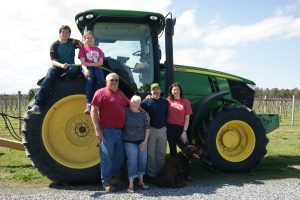
Three times a week, I go out running around a path that I made around three of my soybean fields. Not a single day goes by that I don’t think about the connection between this land and my family.
Earth Day is a day when we all think about the environment, when we look at how we take care of the land and how to leave it in better condition than we found it.
Every day is Earth Day to a farmer. Taking care of the land is my job and my passion. My land is my heritage, my inheritance, my business, my recreation, my safe haven, and my retirement.
No one poisons the well they drink from, and farmers are no exception. Good, clean, productive land is how I feed my children and will put them through college. I may have a piece of paper that says that I own the land, but I know that I am only a caretaker. The land was here long before me, cared for by many generations. I expect it will be here long after me, cared for by my children and their children.
Maryland farmers, as a group, are the most progressive and environmentally minded in the nation. This year, we once again broke the record for cover crop acres planted – one of the most effective ways to protect both our land and the Chesapeake Bay.
We’re far ahead of other milestones set for the Bay, too, including planting streamside forest and grass buffers, retiring highly erodible land, and constructing storage for animal manure, which is an important source of organic nutrients for our crops.
We’ve got soil conservation and water quality plans on half of Maryland’s tillable acres and have embraced the manure transport program, moving four times the amount of manure than the goals prescribed.
I often hear, “Sure family farmers take care of their land, but what about corporate farms?” I don’t know of a single farm that isn’t a family farm (and I know a lot of farmers). Family farms – owned by brothers, by a father and son or daughter, by a husband and wife, or by cousins – often will incorporate for legal or financial reasons. The USDA says that 97 percent of farms in the United States are family-owned operations.
Sometimes these farms are large, because farms, like every other business, have to grow to survive. You can’t go out and make a good living on 100 acres like you could in my grandfather’s day. Today it’s more like 2,000 acres or more for corn and soybean growers.
How can farms that large take care of the land adequately? Technology and innovation. Today it’s possible to do a better job with 3,000 acres than my grandfather could with 100. We no longer have to plow the land, which destroys the structure and biology of the soil and leaves it open to erosion. GPS technology allow us to treat every single acre individually.
Ask a farmer anything about his land, the littlest detail, and he’ll know it. Ask where there are problems with grasses, or pigweed, or marestail, and he’ll know. Ask where the wet spots are, or spots that get as hard as concrete in the summer. Ask where water runs off the land, and where it will pond up. A farmer knows his farm like the back of his hand. Most will tend every acre four or more times a year, planting, scouting, fertilizing, killing weeds and harvesting.
My family has owned the farm I live on for 68 years now. Three generations of Laytons have all been raised in the same house, on the same land. When I watch the sun rise over the fields each morning, I know the only thing more important to me than my land is my family.
Enjoy Earth Day, and make a pledge to see firsthand how farmers make every day Earth Day. We welcome you to visit our farm, or suggest MarylandsBest.net to locate farms near your home to visit, where you can see land and water quality efforts in action.
William H. Layton
Chairman, Maryland Soybean Board william@laytonschance.com
William Layton, his wife Jennifer and his father Joe raise soybeans, corn, wheat and grapes on a 1,300-acre farm in Dorchester County, MD. The family opened Layton’s Chance Winery in 2010.
Archives
No Results Found
The page you requested could not be found. Try refining your search, or use the navigation above to locate the post.