
Maryland Farmers Plant Record-Setting Cover Crop Acres
SALISBURY, MD. (March 3, 2015) – On a cold winter’s day with their fields blanketed in snow, farmers Dave and Linda Burrier don’t get a day off. There’s paperwork to do – lots of it. Maryland farms like Burrier Farms, located in Union Bridge, have to file a nutrient management plan with the state every year. The Burriers, who grow soybeans, hay, corn and wheat on more than 1,200 acres, also raise cattle.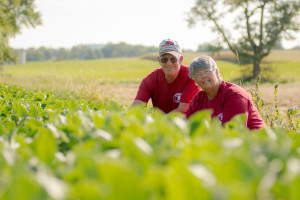
Stewardship of the land isn’t just a legal requirement for these farmers, though. It’s a personal and professional ethic many Maryland farmers share.
So much so, in fact, that Maryland farmers participating in the state’s 2014-2015 Cover Crop Program planted a record 478,000 acres of cover crops on their fields last fall to control soil erosion, reduce nutrient runoff and protect water quality in streams, rivers, and the Chesapeake Bay. The 2014 cover crop planting is the largest in Maryland history, exceeding the previous record of 430,000 acres in 2012.
Maryland farmers exceeded the Phase I and II Watershed Implementation Plan milestone for cover crops in 2011 and 2013 and with this planting, have exceeded the milestone commitment for 2015.
Cover crops are widely considered to be one of the most environmentally sustainable ways to protect water quality in the Chesapeake Bay and its tributaries. Collectively, the 478,000 acres of cover crops planted will prevent an estimated 2.9 million pounds of nitrogen, and 95,600 pounds of phosphorus from impacting waterways.
The Burrier farm has been in the family since 1962, and each year the Burriers strive to improve the soil quality, protect waterways and maintain strict conservation practices.
“The Linganore Creek runs through our farm,” says Dave. “To protect this valuable waterway, we’ve planted hay on both sides of the bank. The hay buffers any sediment or nutrients before they can get to the creek. Similarly, we keep a field that tends to flood permanently planted in grass to protect soil erosion.”
“Caring for the land we farm is important to our family. Conservation is the right thing to do, but it also rewards us with high-quality crops. We also use no-till farming, strip cropping, crop rotations and cover crops,” says Dave.
No-till farming is a practice that grows crops without using tilling, also known as plowing, which can be a major factor in soil erosion. Strip cropping also prevents soil erosion by creating natural dams for water, helping to preserve the strength of the soil. Cover crops such as cold-hardy wheat, rye and barley, are planted in the fall. Once established, the cover crops recycle unused plant nutrients that may remain in the soil from the previous summer crop. They also protect fields against wind and water erosion and improve soil health, increasing organic matter in the soil, reducing weeds and pests, and providing a habitat for beneficial insects.
The Burriers also rotate the crops they plant in a certain field each year.
Off the farm, Dave and Linda have made it a priority to serve on agricultural boards and committees, including the Maryland Soybean Board. In October, Linda was appointed to the United Soybean Board.
“Farming is a business, but it’s also a lifestyle,” says Linda. “Not only do we care about our land deeply, we care about sharing our time in the community. It’s important to give back and to help improve farms and teach farmers about new industry practices.”
About Maryland Soybean Board: The Maryland Soybean Board administers soybean checkoff funds for soybean research, marketing and education programs in the state. One-half of the checkoff funds stay in Maryland for programs; the other half is sent to the United Soybean Board. To learn more about the Maryland Soybean Board, visit www.www.mdsoy.com.
# # #
Summer Fairs to Feature Soy Product
SALISBURY, MD. (June 8, 2015) – Two Maryland fairs will showcase the versatility of “the miracle bean” thanks to support from the Maryland Soybean Board.
First up is the Washington County Ag Expo and Fair, July 18-25 at the Washington County Agricultural Education Center in Sharpsburg. This year, nearly all printed material produced by the fair will be printed with SoyInk, a soy-based alternative to printing inks made from petroleum. SoyInk is more environmentally friendly, provides brighter colors and may make it easier to recycle paper. Learn more about the fair at www.agexpoandfair.org.
On Sept. 20, “Family Farm Day” in Baltimore County will showcase soy-based products which can be used in the home in an exhibit called “Soy Land.” Soy-based materials from furniture to sunscreen, paint to paint removers, insulations, carpet and everything in between will be shown in different rooms of a house – the kitchen, living room, office, play room, bathroom and garage. More information is available at www.marylandagriculture.org.
The soybean, often referred to as the miracle crop, provides a sustainable source of protein and oil worldwide. Soy’s properties allow its use in a variety of applications from animal feed and human consumption, to road fuel and other industrial uses.
For the past decade, U.S. soybean farmers have helped fund the development of many successful new uses for soybeans through the soybean checkoff program. Under the checkoff, farmers contribute one-half of one percent of the net market value of their soybeans for research, marketing and education programs. In 2014, the soybean checkoff helped commercialize 33 new products. All together, more than 800 soy-based products have been developed with checkoff support since 1990, when the national checkoff began.
About Maryland Soybean Board: The Maryland Soybean Board administers soybean checkoff funds for soybean research, marketing and education programs in the state. One-half of the checkoff funds stay in Maryland for programs; the other half is sent to the United Soybean Board. To learn more about the Maryland Soybean Board, visit www.www.mdsoy.com.
# # #
For More Information:
Sandy Davis
(410) 742-9500
Susanne Zilberfarb
(410) 430-2613
Kudzu Bug Update
The University of Maryland reports they have found the kudzu bug in Anne Arundel, Calvert, and Prince George’s Counties on kudzu vines.
Another person has also reported the insect on kudzu vines in Charles County to the SEED network online. The university has collected egg masses from Anne Arundel and Calvert Counties, as of early July 2013.
The university has launched a website, www.MDkudzubug.org to help disseminate information.
Maryland Soybean Board Awards Nearly $200,000 in Checkoff Grants
Fifteen projects, ranging from the development of new seed to how to manage the possible invasion of a new pest, have been approved for checkoff funding by the Maryland Soybean Board. The grants totaled $192,840.
Here’s a rundown…
• A total of $16,570 to Dr. Robert Kratochvil, University of Maryland Extension and oil crop specialist, for two projects – $7,150 to evaluate plant growth and plant health regulators on the agronomic performance of full-season soybeans and $9,420 to see how both full-season and double-crop beans respond to the placement and application rate of potassium fertilizer. Both studies are in response to farmers seeking to “attain the next level of soybean yield” in the Maryland environment, he said.
• A total of $34,250 to Schillinger Genetics for three projects seeking to further develop soybean varieties with traits which would enhance their nutritive value for feed for poultry, fish and shrimp.
• $14,300 to University of Maryland entomologist Dr. Cerutti Hooks to study whether the management of a barley cover crop – in its residue and its herbicide practices – has an impact on the insects, weeds, soil moisture and yield of the soybean crop which will follow it. It is planned as a two-year endeavor.
• $3,090 to Caroline County Extension ag agent Jim Lewis to evaluate how various soybean maturity groups perform under irrigation. Lewis says there is some evidence that farmers are planting seed from a too long maturity group, which, under irrigation, produce tall, lanky plants that easily lodge and have few pods.
• $5,000 to Armando Rosario-Lebron of the University of Maryland Department of Entomology to explore, over a two-year study, the possibility that inter-planting marigolds with soybean could lure to the field an army of natural enemies — parasitic wasps and other predators — to attack the brown marmorated stink bug.
• $4,200 to St. Mary’s County ag agent Ben Beale to continue into a second year his exploration of the causes and extent of Soybean Vein Necrosis Virus in Maryland. Beale said that first year studies indicated that the disease can occur from early spring into the summer and that yields are not greatly affected.
• $7,566 to Dr. Galen Dively, retired University of Maryland entomologist, to continue wide ranging studies related to the control of the brown marmorated stink bug.
• $7,625 to University of Maryland environmental scientist Dr. Ray Weil to study the study the use of sulfur as a fertility agent in soybeans. “We hypothesize,” he wrote, “that sulfur fertilization may provide important benefits to farmers in terms of both yield and protein quality of the soybean crop. If the quality aspects can be documented, sulfur management may open opportunities for premium priced soybeans.”
• $12,215 to University of Maryland entomologist to prepare Maryland farmers for a possible invasion from the south of the kudzu bug. Lamp will prepare educational materials to aid in the detection, the biology and the control and management of the pest which feeds not only on the kudzu vine but soybeans as well.
• $3,185 to Ron Mulford, retired manager of UMD’s Poplar Hill Research Farm near Salisbury and now operating as Mulford Agronomics, to continue his in-the-field studies of foliar fertilizers. Mulford wants to know if the low rate high efficiency fertility programs now being marketed by four companies are as productive as the University of Maryland’s established fertility program for soybeans.
• $20,000 to Dr. Deb Jaisi, a University of Delaware research scientist, to study and identify the origins of potassium in the waters of the Chesapeake Bay. The project is also being supported by the soybean checkoff boards of Delaware and Pennsylvania.
• $64,839 to researchers for the U.S. Geological Survey to capture and analyze water flowing into the Chester River from two parcels – both having been spread with manure but one under irrigation and the other dryland. They are testing a premise that groundwater – down to about 60 feet – contains less nitrate under the irrigation system than that flowing from the dryland. The project is expected to last another two to four years.
Archives
No Results Found
The page you requested could not be found. Try refining your search, or use the navigation above to locate the post.