
Five Reasons to Be Thankful for Maryland Farmers
SALISBURY, Md. (November 21, 2016) – Nothing defines Thanksgiving as much as the turkey and all the trimmings. So it’s natural to think of the farmers who raised the feast and be thankful for the fruits of their labor.
Here are five reasons to be thankful for Maryland farmers this holiday:
- According to Feeding America, 12.7 percent of the Maryland population is food insecure. Let’s thank those farmers who are raising food to feed friends and family, and make it available at roadside stands.
- Maryland farmers have an $8.25 billion impact on the state’s economy, making agriculture the Free State’s Number One industry!
- Maryland’s farms support 45,600 jobs in the agriculture and food sector. Maybe even yours?
- Like their counterparts nationwide, Maryland’s 12,000+ farms are 98% family owned, often through generations.
- If you care about our environment and the Chesapeake Bay, there’s good news: Farms have a lower environmental impact than developed land. Actually, many of Maryland’s farmers have installed “best management practices” on their farms to enhance the environment.
“Maryland farmers ta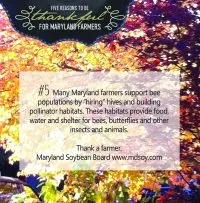
The Maryland Soybean Board administers soybean checkoff funds for soybean research, marketing and education programs in the state. It is funded by farmers through an assessment of one-half of one percent of the net market value of soybeans at their first point of sale. One-half of the checkoff funds stay in Maryland for programs; the other half is sent to the United Soybean Board.
In Maryland, farmers grow about a half a million acres of soybeans, producing more than 20 million bushels of beans each year. With a value of $173 million to the state’s economy, soybeans are one of Maryland’s top crops. For more information on the Maryland Soybean Board, visit www.mdsoy.com.
# # #
For More Information:
Sandra Davis, Executive Director, Maryland Soybean Board
Office: 410.742.9500
sdavis26@verizon.net
University of Maryland Student Attends Biotech University
Jacob Taylor, a graduate student of the Philip Merrill College of Journalism at the University of Maryland, recently completed Biotech University thanks to a scholarship from the Maryland Soybean Board.
Taylor, of Elkridge, Md., completed the one-day course held at the Cronkite School of Journalism at Arizona State University in Phoenix Oct. 28. The course included classroom and lab work on biotechnology, including a hands-on DNA extraction experiment and a farm tour.
He now has the opportunity to compete in a multimedia contest to win scholarships and additional travel opportunities.
“In the Chesapeake region we rely on innovation to succeed as farmers. Biotechnology offers us the opportunity to choose soybean varieties which allow us to farm more sustainably and efficiently,” says Travis Hutchison, a Cordova, Md., farmer and chairman of the Maryland Soybean Board. “We hope that, through Biotech U, we are allowing the next generation of journalists to learn about biotechnology and be able to present biotech stories with knowledge and balance.”
Biotech U is co-sponsored by the United Soybean Board, the National Corn Growers Association, the Arizona State University Biodesign Institute and Arizona Farm Bureau.
The Maryland Soybean Board administers soybean checkoff funds for soybean research, marketing and education programs in the state. It is funded by farmers through an assessment of one-half of one percent of the net market value of soybeans at their first point of sale. One-half of the checkoff funds stay in Maryland for programs; the other half is sent to the United Soybean Board.
In Maryland, farmers grow about a half a million acres of soybeans, producing more than 20 million bushels of beans each year. With a value of $173 million to the state’s economy, soybeans are one of Maryland’s top crops. For more information on the Maryland Soybean Board, visit www.mdsoy.com.
# # #
For More Information:
Sandra Davis, Executive Director, Maryland Soybean Board
Office: 410.742.9500
sdavis26@verizon.net
Officers Elected for Maryland Soybean Board
(SALISBURY, MARYLAND) – Travis Hutchison of Cordova, Md., has been elected chairman of the Maryland Soybean Board. Hutchison succeeds William Layton, who has retired from the statewide board after reaching the term limits.
Brian Johnson of Westover was elected vice chairman and Danny Saathoff of Denton was elected treasurer at the board’s August meeting. The directors officially assumed their duties Oct. 1.
Ten farmer-directors volunteer their time on the Maryland Soybean Board, which administers soybean checkoff funds for soybean research, marketing and education programs in the state. Hutchison, Johnson and Saathoff are joined by Alan Hudson of Berlin, Randy Stabler of Brookeville, Linda Burrier of Union Bridge, Joshua Appenzeller of Millington, Bill Langenfelder of Worton, Jeffrey Griffith of Lothian and Jason Spicer of Church Creek.
April Cheesman of Perdue Farms, Inc.; Jim Lewis of the University of Maryland Extension Service and Mark Powell of the Maryland Department of Agriculture serve as ex-officio members.
In Maryland, farmers grow about a half a million acres of soybeans, producing more than 20 million bushels of beans each year. With a value of $173 million to the state’s economy, soybeans are one of Maryland’s top crops.
The checkoff program is funded by farmers through an assessment of one-half of one percent of the net market value of their soybeans at the first point of sale. One-half of the checkoff funds stay in Maryland for programs; the other half is sent to the United Soybean Board.
For more information on the Maryland Soybean Board, visit www.mdsoy.com.
# # #
For More Information:
Sandra Davis, Executive Director, Maryland Soybean Board
Office: 410.742.9500
sdavis26@verizon.net
Spicer Named Director on Maryland Soybean Board
Salisbury, MD. (October 11, 2016) – Jason Spicer, a 39-year-old row crop farmer from Dorchester County, is the newest member of the Maryland Soybean Board.
Spicer began his first three-year term on the board on Oct. 1, succeeding William Layton, who farms near Vienna. Layton completed the board’s maximum three, three-year terms on the 10 farmer-member board.
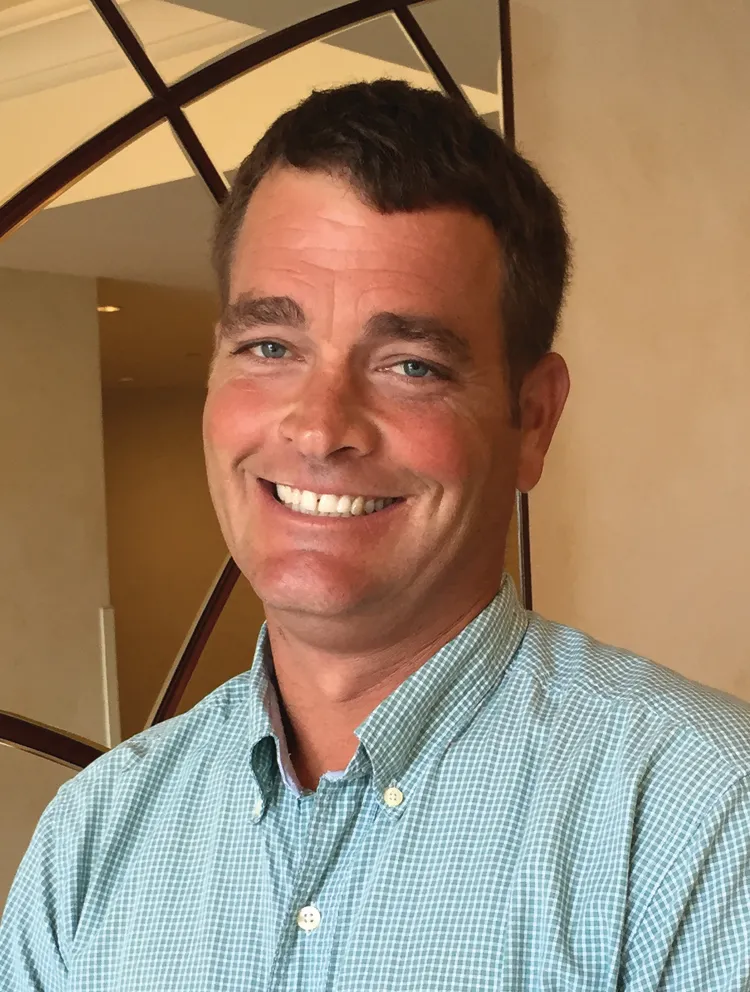
Jason Spicer Named Director on Maryland Soybean Board
Spicer owns and operates Holly Lane Farms, near Cambridge in the area of Church Creek. He is a member of and the expansive and well-known Spicer family scattered through Dorchester County.
“If the name is Spicer and they live in these parts, we are all related,” he said.
Holly Lane Farms tills about 1,200 acres – some owned, some rented – in the traditional rotation of corn, soybeans and wheat. “We bale some hay and straw,” Spicer said, adding that the farm also includes an important timber cutting operation. “We do logging to pay for the farm,” he said with a smile.
Spicer’s wife, Holly, is a teacher at Sandy Hill Elementary School. The couple has a daughter, Sophie, who will turn three years of age on Nov. 2. Spicer himself will turn 40 on Nov. 2. “I can never forget her birthday, or mine,” he said with a chuckle.
The Maryland Soybean Board administers soybean checkoff funds for soybean research, marketing and education programs in the state. One-half of the checkoff funds stay in Maryland for programs; the other half is sent to the United Soybean Board.
In Maryland, farmers grow about a half a million acres of soybeans, producing more than 20 million bushels of beans each year. With a value of $173 million to the state’s economy, soybeans are one of Maryland’s top crops. For more information on the Maryland Soybean Board, visit www.mdsoy.com.
About Maryland Soybean Board: The Maryland Soybean Board administers soybean checkoff funds for soybean research, marketing and education programs in the state. One-half of the checkoff funds stay in Maryland for programs; the other half is sent to the United Soybean Board. To learn more about the Maryland Soybean Board, visit www.mdsoy.com.
# # #
For More Information:
Sandra Davis, Executive Director, Maryland Soybean Board
Office: 410.742.9500
sdavis26@verizon.net
Archives
No Results Found
The page you requested could not be found. Try refining your search, or use the navigation above to locate the post.