
Road Safety Campaign Highlights Awareness of Farm Equipment Drivers for Motorists
Maryland motorists can help reduce farm-related accidents.
The Maryland Soybean Board, with support from the United Soybean Board, is partnering in the “Find Me Driving” road safety campaign to raise motorists’ awareness of farm equipment drivers on the roads this spring.
“As rural accidents are increasing in number with greater physical and economic losses, the Maryland Soybean Board proactively identified farm vehicle road safety awareness as a priority and launched the campaign,” commented Belinda Burrier, MSB Chair and USB Director. “We are delighted that our fellow soybean organizations are joining in this safety initiative.”
According to data from the National Highway Traffic Safety Administration, only 30% of the total vehicle miles traveled in 2017 were in rural areas, yet 46% of all traffic fatalities in 2017 occurred in rural areas. The fatality rate per 100 million vehicle miles traveled in the U.S. was 2.1 times higher in rural areas than urban areas. Every state reported a higher percent of rural area fatalities than urban areas.
“As farm planting season activity increases this spring, drivers can increase awareness to help prevent accidents,” continued Burrier. “These helpful resources are available for everyone to use to learn about what to look for on rural roads and how to prepare for safely navigating rural roads in our region.”
 Online Find Me Driving campaign resources feature SAM, the campaign’s mascot, whose name means ‘Slow down, Assess your surroundings, Move with caution’ and resembles the high-reflectance slow moving vehicle triangle emblem required on all vehicles traveling under 25 mph. Visitors to the site can find tips about how to safely drive when encountering farm equipment and encourages motorists to look for the bright orange triangle on tractors, combines, maintenance trucks and other large, slow-moving vehicles. Resources also include lighting and marking guidelines for farm equipment, as well as tips when driving slow moving vehicles in traffic.
“Our state is small in size but ranks fifth in population density, which increases the chances Maryland motorists will encounter farm vehicles and equipment on public roads,” concludes Burrier. “We want drivers to be prepared and arrive home safe.”
About Maryland Soybean Board: With a value of $173 million to the state’s economy, soybeans are one of Maryland’s top crops. The Maryland Soybean Board works to maximize the profitability of Maryland soybean producers by investing Maryland checkoff funds in research, promotion, and communication projects. Learn more about soybeans in Maryland by visiting www.mdsoy.com.
About United Soybean Board: United Soybean Board’s 78 volunteer farmer-directors work on behalf of all U.S. soybean farmers to achieve maximum value for their soy checkoff investments. These volunteers invest and leverage checkoff funds in programs and partnerships to drive soybean innovation beyond the bushel and increase preference for U.S. soy. That preference is based on U.S. soybean meal and oil quality and the sustainability of U.S. soybean farmers. As stipulated in the federal Soybean Promotion, Research and Consumer Information Act, the USDA Agricultural Marketing Service has oversight responsibilities for USB and the soy checkoff. For more information on the United Soybean Board, visit unitedsoybean.org.
Contact: Danielle Farace, Executive Director
Maryland Soybean Board
Office: 443.812.4526
danielle@mdsoy.com
Soybean Farmers Applaud Maryland Department of Transportation
Maryland Soybean Board to partner in education outreach
The Maryland Soybean Board praises the Maryland Department of Transportation for their innovative consideration of farmers in their recently released 2021-2025 Maryland Strategic Highway Safety Plan (SHSP). The plan is the latest update to identify strategies and actions to eliminate fatalities on all Maryland roadways. This update is the first of which to address rural communities and farm equipment concerns.
“The SHSP addresses safety specific to Maryland roadways across urban, suburban and rural communities,” states the Maryland Department of Transportation (MDOT) in the announcement of the plan. “For example, in many areas the roadway use changes when farm equipment needs to travel alongside other vehicles. In a case like this, crash prevention measures – such as fixed and mobile road signs warning of slow-moving vehicles and outreach campaigns – will be among strategies used to raise awareness of unique needs of rural communities and farm operations on Maryland roads.”
The Maryland Soybean Board (MSB) completed the Maryland Rural Road Safety Study in 2019, which analyzed farm vehicle and farm equipment related in the State of Maryland. Conclusions from the study found that education for all drivers, both of farm vehicles and standard motor vehicles, will play a key role in reducing the number of farm vehicle collisions; and that it was imperative for farm vehicles to be recognized in the SHSP. The Maryland Soybean Board worked with the Maryland Department of Agriculture and other stakeholders to put those findings into action.
“Road safety is a top priority for Maryland soybean farmers,” proclaimed MSB Chair Belinda Burrier. “We are pleased to see that the Maryland Department of Transportation is taking these concerns seriously by becoming one of the first states in the nation to include farm equipment in their highway safety plan.”
The MSB will continue to work with MDOT to further education efforts surrounding farm vehicle collisions. Most recently, MSB released www.findmedriving.com, a website providing driving tips for navigating around slow moving vehicles on the roadway. It features an orange triangle mascot, SAM, as a reminder for drivers for when they see a slow moving vehicle to Slow down, Assess their surroundings, and Move with caution. Burrier has also been appointed to represent farmers on the MDOT Motor Vehicle Administration Highway Safety Speed Emphasis Area Team.
“Serving in this role, I look forward to not only sharing my experience to prevent farm vehicle collisions, but also voicing concerns on other opportunities to make roadways safer for farmers, including roadway construction, maintenance, and more,” she states.
In Maryland, farmers grow about a half a million acres of soybeans, producing more than 20 million bushels of beans each year. With a value of $173 million to the state’s economy, soybeans are one of Maryland’s top crops. The checkoff program is funded by farmers through an assessment of one-half of one percent of the net market value of their soybeans at the first point of sale. One-half of the checkoff funds stay in Maryland for programs; the other half is sent to the United Soybean Board.
For more information on the Maryland Soybean Board, visit www.mdsoy.com.
# # #
Danielle Farace, Executive Director
Maryland Soybean Board
Office: 443.812.4526
danielle@mdsoy.com
Soybeans Fuel Local Food Donations
Maryland soybean farmers applaud their number one customers in animal agriculture who aided in keeping food on table for local families during unprecedented times. According to the Maryland Food Bank, agricultural corporations such as Perdue Farms, Inc., Smithfield Foods, and Tyson Chicken donated over 1.3 million pounds of protein-rich foods in 2020.
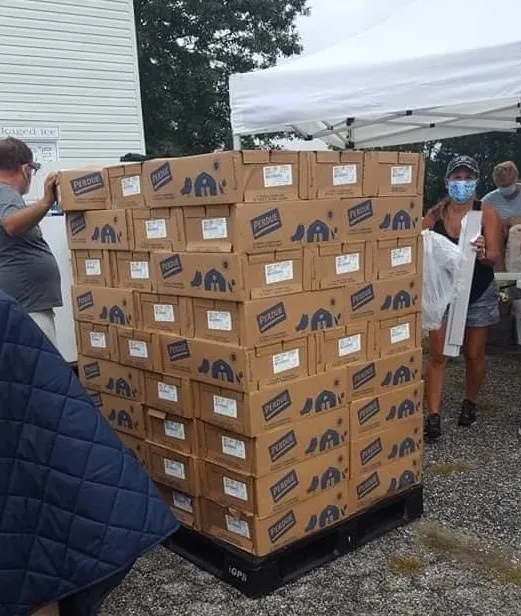 “As Marylanders have increasingly relied on food pantries over the past year, we are pleased to see our partners in the supply chain give to help those in need,” said Maryland Soybean Board Chair Belinda Burrier.
Maryland farmers sustainably grow high-quality soybeans on approximately half a million acres throughout the state. Many of these farmers grow genetically modified (GMO) crops, which allow them to fully embrace conservation practices such as cover crops, no-till farming, and crop rotation. Using these practices, farmers can combat climate change by sequestering carbon, reducing soil erosion, and improving water quality.
While soybeans have many uses, the majority grown in Maryland are sold to the animal agriculture sector, where they are crushed into soybean meal and used for feed. Soybeans provide an excellent source of protein, essential amino acids, and other value nutrients for poultry, pigs, beef and dairy cattle, and more.
Poultry companies on the Delmarva, such as Perdue Farms, Inc. and Tyson Chicken, purchase 38 million bushels of soybeans each year for chicken feed. The nutritious diet that soybeans provide efficiently grows high-quality chickens. In turn, these chickens provide a low-calorie and low-fat protein source for humans that builds muscle, promotes heart health, strengthens bones, and more.
With a value of $173 million to the state’s economy, soybeans are one of Maryland’s top crops. The Maryland Soybean Board works to maximize the profitability of Maryland soybean producers by investing Maryland checkoff funds in research, promotion, and communication projects. Learn more about soybeans in Maryland by visiting www.mdsoy.com.
# # #
Danielle Farace, Executive Director
Maryland Soybean Board
Office: 443.812.4526
danielle@mdsoy.com
Soybean Growers Participate in Virtual Leadership Training
Two Maryland farmers participated in the American Soybean Association’s Soybean Leadership Academy earlier this month. Belinda Burrier of Union Bridge, and Evan Staley of New Windsor, both representatives of the Maryland Soybean Board, joined over 160 other participants from across the country in completing the training.

Photo: United Soybean Board
“This annual program continually brings value to those who attend,” said Burrier, current MSB Chair. “Although the virtual format was different this year, there were engaging speakers who made it easy to learn from the comfort of the farm.”
The Soybean Leadership Academy is designed to provide tools and techniques that enable state and national soybean board leaders to be more effective, efficient, and inspired leaders. Throughout the program, participants had the opportunity to engage with each other and speakers, both on camera and through chat, and in some states, in person.
This year’s event offered two different tracks for attendees, an Executive track for top state and national farmer leaders which Burrier participated in, and a Beginning/Intermediate track for new farmer leaders which Staley participated in. Featured speakers included Neen James, author of Attention Pays; Vance Crowe, communications consultant; Dr. Matt Roberts, economist; Dan Farney, chairman, USB; Darryl Chatman, senior vice president, governance and compliance, USB; and Christy Seyfert, ASA executive director of government affairs.
“With this being my second year on the Maryland Soybean Board, the program helped me to get a better understanding of the workings of the checkoff organization,” Staley commented. “I would recommend the training to anyone who is interested in becoming involved with the soybean industry.”
In Maryland, farmers grow about a half a million acres of soybeans, producing more than 20 million bushels of beans each year. With a value of $173 million to the state’s economy, soybeans are one of Maryland’s top crops. The checkoff program is funded by farmers through an assessment of one-half of one percent of the net market value of their soybeans at the first point of sale. One-half of the checkoff funds stay in Maryland for programs; the other half is sent to the United Soybean Board.
For more information on the Maryland Soybean Board, visit www.mdsoy.com.
# # #
Danielle Farace, Executive Director
Maryland Soybean Board
Office: 443.812.4526
danielle@mdsoy.com
Archives
No Results Found
The page you requested could not be found. Try refining your search, or use the navigation above to locate the post.