
This Thanksgiving Season Be Thankful for Maryland’s Family Farms
November 25, 2015 – Thanksgiving is a time for food, family and fellowship. For Maryland family farmers, it’s also a time to be thankful that the year’s crops have been harvested and that their animals have had another year of superior care.
Recently completed USDA census data has found that that 97 percent of farms in the U.S. are family-owned businesses. These farms are very diverse, but remain the core of the U.S. agriculture industry.
On Pleasant Valley Farm, family is the centerpiece of the farming operation. Located in Brookville, Md., the farm is run by two father-son partners: Robert and Randy Stabler and Breck and JB Debnam. Randy’s daughters, Kelsey Thomas and Shelby Stabler, are also involved in the day-to-day operations.
“Our families have a passion for agriculture,” says Randy Stabler. “We love what we do and take pride in producing high-quality food for our neighbors.”
Pleasant Valley Farm grows soybeans and corn on 2,500 acres, as well as selling natural, grain-fed Black Angus beef and fresh sweet corn at their farm stand.
“One of the reasons we love farming is the opportunity to work with our families,” says JB Debnam. “After working off the farm for 12 years, I came back to work with my dad and Randy’s family, and it was one of the best decisions of my life.”
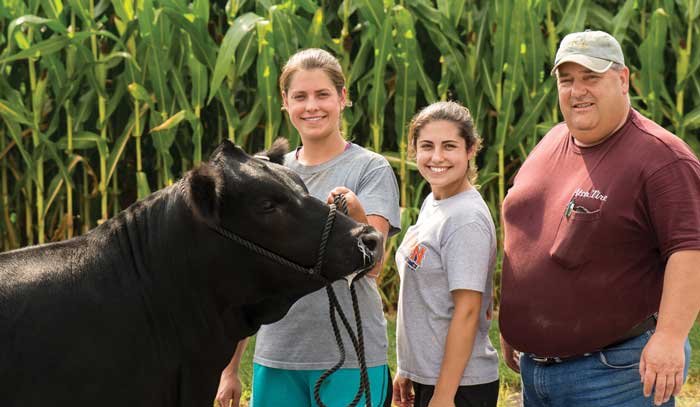
“Together, we’ve been able to build a farm that is sustainable and will be an opportunity for the next generation,” says Randy. “We can sustain both families, and each of us has the ability to realize our dreams.”
To learn more about soybeans and how they are used on Maryland farms, visit www.www.mdsoy.com.
The Maryland Soybean Board administers soybean checkoff funds for soybean research, marketing and education programs in the state. One-half of the checkoff funds stay in Maryland for programs; the other half is sent to the United Soybean Board. To learn more about the Maryland Soybean Board, visit www.www.mdsoy.com.
Know Your SCN Numbers
Click here to download the latest information on SCN and find out how to have your soil tested.
Ice Cream is Part of This Farm’s Story
SALISBURY, MD. (July 19, 2015) –Ice cream may be ubiquitous to summer, but for one dairy farmer in Tuscarora, Md., this sweet treat is much more, it’s part of his family’s story. In 2009, Chuck Fry, and his wife, Paula, were looking for a way to diversify the income from their dairy farm.
“I’ve always taken a milk stool approach,” says Fry. “Our business, like a milk stool, should have three legs. For us, two of those legs are the cows and the crops. We were looking for a third leg to complete our family business.”
It was Paula who convinced Chuck to consider making and selling ice cream on their farm. Centrally located off a main highway to Frederick, Md. and Leesburg, Va., Rocky Point Creamery would be able to serve two large metro populations.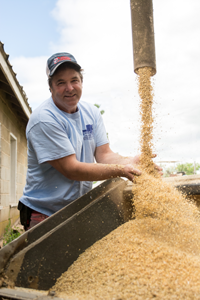
Several years of research and planning followed, and in 2011, the Fry’s broke ground on the Creamery building, situated at the entrance to their dairy farm. The family started serving their homemade ice cream soon after, and now, there is a steady stream of customers.
“We knew our customers would come from Frederick and Leesburg, but actually, we have many customers from Washington, D.C. For them, it’s a destination, a chance to experience a real, live dairy farm,” says Fry.
While customers may see the farm as a destination, to Chuck, a fourth generation farmer, the farm is his family’s lifestyle and livelihood.
“Our cows are our number one priority,” says Fry. “From the high-quality feed they eat, to the superior veterinarian and herdsman care, to the clean and open housing, each cow is treated with respect.”
One of the feeds that the cows at Rocky Point Farm turn into delicious ice cream is fresh ground and roasted soybeans.
“Maryland dairy farmers feed more than 9,000 tons of soybean meal each year,” says Fry. “On our farm, we grow, harvest, roast and grind the soybeans ourselves. On demand roasting and grinding helps retain the good oil in the soybeans. Combined with other quality feeds, our cows eat to produce premium milk.”
That milk is turned into the ice cream that Rocky Point Creamery customers enjoy.
“Ice cream fresh from our farm,” says Fry. “That’s our motto, and our promise to our customers. Being able to share a little slice of our family farm with our customers is wonderful.”
Maryland farmers grow about a half a million acres of soybeans every year, harvesting between 16 to 20 million bushels that are used to feed poultry and livestock.
According to the United Soybean Board, animal agriculture in Maryland represents $2.4 billion in economic output, $394 million in household income, and 14,300 jobs.
In addition, it yielded an estimated $99 million in income taxes and $48 million in property taxes.
To learn more about Rocky Point Creamery, visit www.rockypointcreamery.com.
Maryland Soybean Board Funds Research
SALISBURY, MD. (June 16, 2015) – A multi-year project lead by the U.S. Geological Survey to monitor the nutrient quality and the age of groundwater as it leaves farm fields along the Upper Chester River continues in Queen Anne’s County.
Funding the project for the 2015-2016 year has been approved by the Maryland Soybean Board.
The $39,923 soybean checkoff grant was one of a total of 10 grants totaling $180,887 authorized by the board before spring planting. The Maryland Soybean Board administers the soybean checkoff program in the state. Through the soybean checkoff, farmers contribute one-half of one percent of the net market value of soybeans at the first point of sale to support research, marketing and education projects.
USGS investigators are monitoring the groundwater that percolates through the ground from both irrigated and dryland corn and soybean fields. They want to know what’s in that water in the way of nutrients – fertilizers – and how long it takes that water to get from the field to the stream.
The research is being supported also by the Maryland Grain Producers Association and is expected to take another two years to complete.
Here’s a rundown on the other checkoff grants awarded by the board:
- A total of $22,106 for two projects by Dr. Robert Kratochvil, University of Maryland grain specialist. He is exploring the role of variety maturity and planting date on the performance of dry-land double crop soybeans, and secondly, the response of full season irrigated soybeans to poultry manure.
- $20,000 to Schillinger Seeds to support the development of non-GMO varieties to be used in feed for poultry and fish. Schillinger is a national firm with a research farm in Queenstown on the Eastern Shore.
- $13,550 to University of Maryland entomologist Dr. Cerruti Hooks to lead a study of how and when to kill a rye cover crop and how that choice may impact soil moisture and soil temperature or weed populations.
- $25,962 to retired University of Maryland entomologist Dr. Galen Dively, who wants to know whether repeated use of herbicide-treated seed has any impact on non-target bugs on the crop above the soil or microbes in the soil under it.
- $24,426 to Dr. Ray Weil, University of Maryland soils who has plotted a six-point study ranging from determining if early planted cover crops can capture the nitrogen that is deep in the soil profile to evaluating the effect of aerial application of early cover crops into standing soybean or corn crops.
- $ 20,000 to University of Delaware plant pathologist Dr. Jeb Jaisi to continue his exploration of the origins of phosphorous in the Chesapeake Bay.
- $6,550 to Dr. William Lamp and Jessica Grant to look at the over-wintering rate of the kudzu bug in Maryland and what the degree-day requirements are for the pest to colonize in Maryland soybeans.
- $8,370 to Caroline County ag agent Jim Lewis to determine the soybean maturity capable of producing, in Maryland, the highest yield with irrigation and at an early or late planting date.
About Maryland Soybean Board: The Maryland Soybean Board administers soybean checkoff funds for soybean research, marketing and education programs in the state. One-half of the checkoff funds stay in Maryland for programs; the other half is sent to the United Soybean Board. To learn more about the Maryland Soybean Board, visit www.www.mdsoy.com.
# # #
For More Information:
Sandy Davis, Maryland Soybean Board
(410) 742-9500
Sdavis26@verizon.net
Archives
No Results Found
The page you requested could not be found. Try refining your search, or use the navigation above to locate the post.